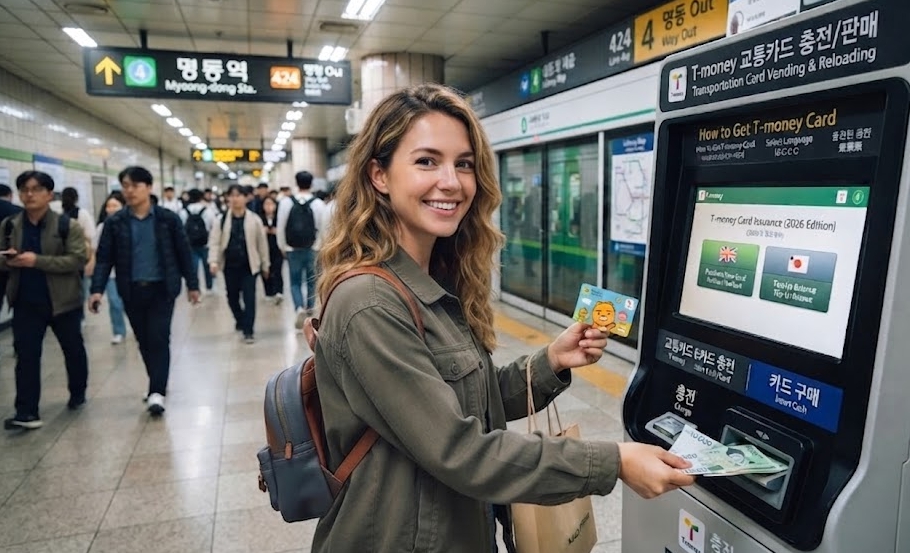
Stepping out of Incheon International Airport and into the high-speed pulse of South Korea is an exhilarating experience. The neon signs, the crisp air, and the sprawling modern infrastructure make you eager to start exploring. However, for almost every international traveler landing in Seoul or Busan for the first time, a sudden wave of logistical anxiety hits right at the subway station gates: How do I pay for public transportation? How do I transfer lines? Do I need a separate ticket for every single ride?
As a local resident who has spent years rescuing bewildered tourists at subway turnstiles with expired paper tickets or rejected credit cards, I can tell you that the single most important tool for surviving and thriving in Korea is not a smartphone translation app—it is a T-Money Card.
Without a T-Money card, navigating Korea’s world-class public transit network becomes an expensive, time-consuming puzzle of single-journey paper ticket deposits and coin exchanges. But with this little plastic card in your pocket, you can seamlessly tap, ride, and transfer across subways, city buses, and even pay for late-night taxi fares or convenience store snacks like a seasoned local.
In this comprehensive, up-to-date 2026 guide, we will break down everything you need to know about getting, topping up, and using a T-Money card in South Korea, saving you time, money, and transit headaches.
1. What is a T-Money Card and Why Do You Absolutely Need One?
A T-Money Card is South Korea’s universal, reusable contactless smart card designed primarily for public transportation. Think of it as your all-in-one key to mobility across Seoul, Busan, Jeju, and virtually every other major city in the country.
Why You Can’t Travel Without It:
- Universal Acceptance: It works on subways, city buses, airport limousines, village buses, and taxis throughout South Korea.
- Massive Transfer Discounts: If you use a single-journey paper ticket, you pay a full fare every time you switch transport modes. With a T-Money card, transferring between a subway and a bus (or bus-to-bus) within 30 minutes is heavily discounted or entirely free (up to 4 transfers within a specific distance threshold).
- Cashless Convenience: Traditional coin and paper cash transactions are rapidly disappearing in Korea. T-Money allows you to tap and go instantly.
- Retail Utility: It functions as a prepaid debit card at almost all major convenience store chains (CU, GS25, 7-Eleven, Emart24), vending machines, and even select franchise coffee shops.
2. Types of T-Money Cards Available in Korea
Not all T-Money cards are created equal. Depending on your personal travel style, budget, and aesthetic preferences, you can choose from several varieties:
1. Standard Plastic T-Money Card (Most Common)
- Price: Around 4,000 to 5,000 KRW (card purchase fee, non-refundable).
- Where to Buy: Any convenience store (GS25, CU, 7-Eleven, Emart24) or subway station ticket vending machine.
- Design: Standard cards feature plain designs, while collectible versions feature K-pop idols, LINE Friends, Kakao Friends characters, or traditional Korean art.
2. Korea Tour Card (Special Edition for Foreigners)
- Price: Around 4,000 KRW.
- Where to Buy: Airport convenience stores, automated kiosks, and selected banks.
- Perks: Besides functioning as a standard T-Money card, it often grants special discount coupons for tourist attractions, duty-free shops, and entertainment complexes in Seoul.
3. T-Money Tourist Reward Card / Climate Card Options
- Note on Climate Card (Gihoewang-gwon): For travelers staying long-term (over a week) exclusively within Seoul, the unlimited-use Seoul Climate Card is an alternative option. However, for standard short-term tourists visiting multiple cities or regions outside Seoul, the classic T-Money card remains the absolute best choice because it operates on a pay-as-you-go balance system.
3. Where and How to Buy a T-Money Card (Step-by-Step)
Buying a T-Money card takes less than two minutes. Here are the easiest ways to secure one upon arrival:
Step 1: Head to an Airport Convenience Store
As soon as you clear customs at Incheon International Airport (Terminal 1 or Terminal 2), look for a convenience store such as CU, GS25, or 7-Eleven.
- Walk up to the counter and show them this phrase or simply say: “T-Money card, please.”
- Pro-Tip: Buy the card and load your initial balance in cash right at the convenience store counter. Convenience store cashiers are accustomed to setting up cards for foreign travelers and will load your desired amount instantly.
Step 2: Use Subway Station Ticket Vending Machines
If you missed buying one at the airport, every single Seoul subway station features multilingual ticket vending machines (supporting English, Chinese, and Japanese).
- Look for the “Transportation Card Vending Machine” or touch the screen to select English.
- Choose the option to purchase a new T-Money card.
- Insert cash (credit card reloads are rarely supported at these machines for initial card purchases, so keep cash handy) and collect your card and change.

4. How to Top Up (Reload) Your T-Money Card
Because T-Money is a prepaid card, you must keep a positive balance to ride public transit. When your balance gets low, topping up is remarkably simple:
Method A: Subway Station Ticket Machines (Cash Only)
- Walk up to any subway station ticket reloading machine.
- Change the screen language to English.
- Place your T-Money card on the designated wireless sensor pad.
- Select your desired top-up amount (e.g., 10,000 KRW or 20,000 KRW).
- Insert cash (KRW banknotes or coins) into the machine. The machine updates your balance instantly.
Method B: Convenience Store Counters (Cash or Card)
- Hand your T-Money card to the cashier at any CU, GS25, or 7-Eleven.
- Tell them the amount you wish to load (e.g., “Ten thousand won, please”).
- Pay using cash or, at most major convenience stores, your international credit card.
- How much should you load initially? For a standard 3-to-5 day trip in Seoul, loading 20,000 to 30,000 KRW to start is a safe bet. You can always top up more as needed.
5. How to Use T-Money Like a Local (Riding & Transferring)
Using the card is completely seamless once you get the hang of it:
- Boarding Subways: Tap your card on the electronic turnstile scanner as you enter, and tap it again when you exit. Warning: Never throw away your card or pass through exit gates without tapping out, or you will be charged a maximum distance penalty fee!
- Boarding City Buses: Tap your card on the card reader right next to the driver as you step onto the front door of the bus.
- The Transfer Ritual: When exiting a bus or subway, always tap your card on the reader at the exit gate or bus back door. If you transfer to another bus or subway within 30 minutes of exiting, the system automatically registers a transfer discount. If you forget to tap out when exiting a bus, you forfeit your transfer discount and get charged an extra base fare.
6. Pro-Tips, Refunds, and Troubleshooting
- Checking Your Balance: You can see your remaining balance on the digital screen of subway turnstiles every time you tap out, or ask any convenience store cashier to check it for you.
- Getting a Refund: If you are leaving Korea and have a significant amount of cash left on your T-Money card, you can get a cash refund at any major convenience store counter (a small service fee of around 500 KRW applies). However, many travelers prefer to keep the card as a souvenir or spend the remaining balance on snacks at the airport convenience store before departure!
- Lost Cards: Standard T-Money cards are anonymous bearer cards (like cash). If you lose your physical card, the balance cannot be recovered, so keep it secure in a dedicated cardholder or wallet pocket.
Frequently Asked Questions (FAQ)
Q1: Can multiple people share a single T-Money card?
A: No. Each traveler must have their own individual T-Money card. You cannot pass a single card back and forth through a subway turnstile for two people. If you are traveling with children or family members, everyone needs a separate card configured to their age group (child/teen/adult) to receive correct fare discounts.
Q2: Can I use my T-Money card to pay for taxis in Korea?
A: Yes, absolutely! Most official Seoul and Busan taxis are equipped with T-Money card readers. Before starting your ride, you can ask the driver (“T-Money card okay?”), and upon arrival, simply tap your card on the payment terminal in the back seat. However, it is always wise to keep a little emergency cash handy just in case a rural taxi’s card machine malfunctions.
Q3: Can I reload my T-Money card using an international credit card?
A: At subway station ticket vending machines, reloads are strictly cash-only (KRW paper bills and coins). However, you can easily reload your T-Money card using an international credit card at convenience store counters (CU, GS25, 7-Eleven) across the city.
Conclusion
Mastering public transportation in a foreign country can feel intimidating at first, but with a T-Money card in your hand, you hold the key to effortless exploration across South Korea. From zipping through Seoul’s subterranean subway maze to catching scenic city buses and buying late-night snacks, this small plastic card will make your trip smooth, economical, and stress-free. Grab your T-Money card right after landing, follow this guide, and enjoy an unforgettable, seamless journey through Korea!